SELECTED WORK / 02 / CUSTOMER ACCOUNTING APP
From manual payment tracking
to one clear system.
A business needed a clearer way to manage monthly charges and incoming payments, especially when payments came from different people, arrived late, were split across transactions or needed manual review.
Talk about an operational tool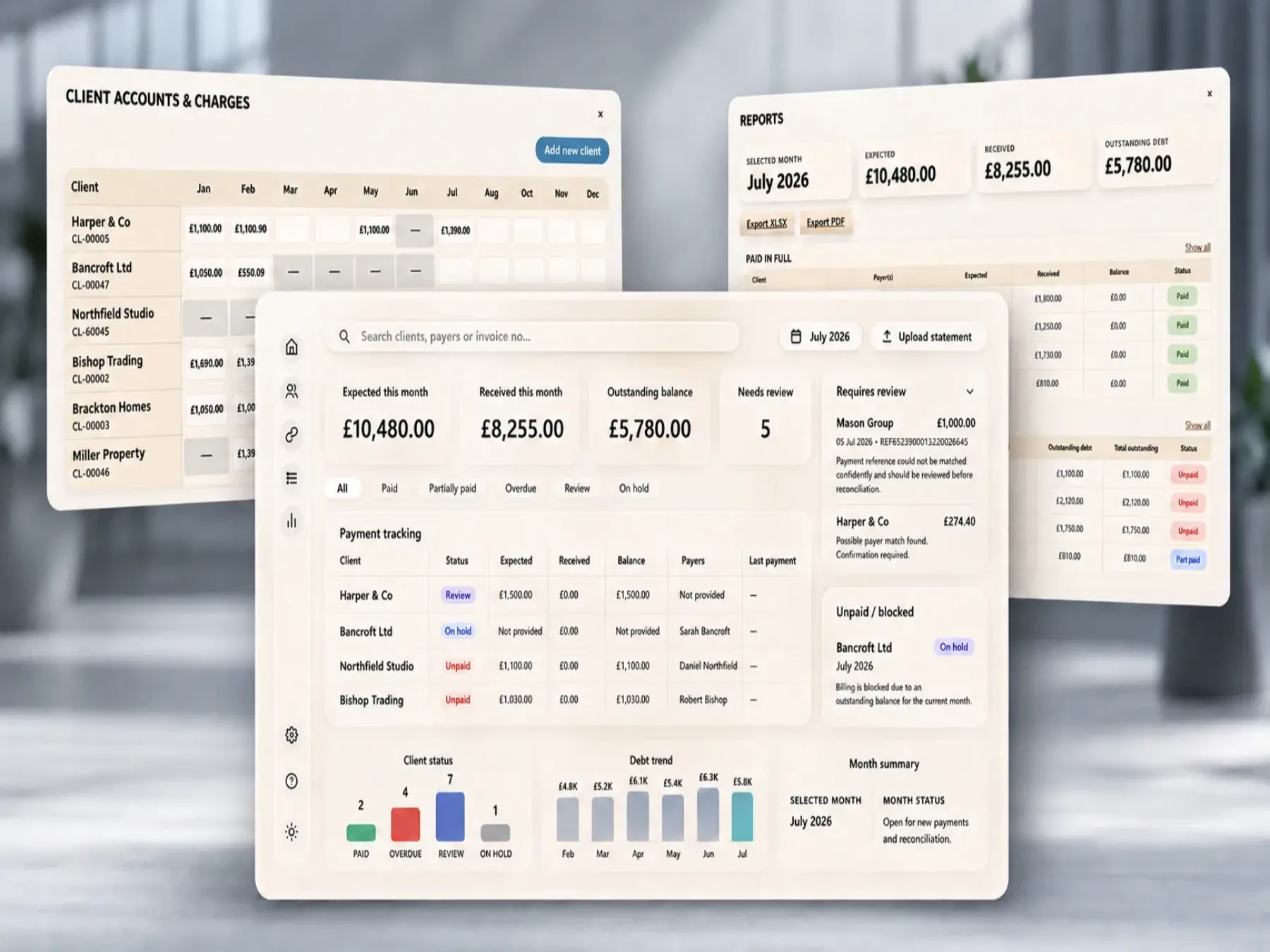
01 / THE PROBLEM
A payment is not always a simple match.
Monthly charges and incoming payments did not always line up neatly. A payer could be different from the customer. Money could arrive late or in several transactions. Some payments needed a person to review the match.
The business needed to understand the monthly position without continually piecing together charges, transactions, balances and exceptions by hand. The work had to account for the real operating detail rather than assume every payment was straightforward.
02 / THE RESPONSE
Bring the month into view.
Studio DALI built a bespoke accounting and payment-reconciliation app that imports bank statements, matches payments to the right customer or payer, tracks balances and arrears, flags exceptions, and brings the month’s position into one clear dashboard.
Uncertain items remain visible for review. The system brings together what has been charged, what has been received and where attention is still needed.
03 / THREE CONNECTED VIEWS
Overview, operational detail and reports.
The main dashboard
A month-level view of expected and received amounts, outstanding balances, account status and reconciliation exceptions. Debt trends and items needing review make the wider position visible.
Client accounts & charges
Account-level planning supports recurring monthly charges, different monthly amounts and inactive or no-charge months. The full-year charge grid sits behind the monthly summary.
Reports
The reporting view separates paid-in-full accounts from outstanding debt, including current-month and earlier debt. Export controls support XLSX and PDF reports.
04 / WHAT CHANGED
One place to review and reconcile.
What previously had to be pieced together manually can now be reviewed, reconciled and managed from one private system.
The public reconstruction shows the application’s functional structure without exposing the client’s identity or real financial information. Its illustrative values describe the interface, not business performance or results.
LET’S TALK
What are you piecing together manually?
You do not need a technical brief. Tell us what you want to improve. We’ll explain a sensible way forward, what it would involve and what it is likely to cost.
Tell us about itThe next step is non-binding. You decide whether to take it further.